Phineas Quimby: The Mind-Healer Who Laid the Foundation for Modern Manifestation [The New Thought Father]
Before The Secret and Abraham-Hicks, before even Neville Goddard—there was a clockmaker from Maine who discovered something revolutionary: thoughts could heal. His name was Phineas Quimby. While you’ve probably never heard of him, his fingerprints are all over the manifestation techniques you’ve tried.
Table of Contents:
Key Takeaways: Phineas Quimby’s Legacy
- Phineas Quimby (1802-1866) was a clockmaker who became America’s first mental healer, proving mind creates matter 170 years ago
- Core principle: All illness originates in false beliefs; correcting mental “errors” heals the body
- His influence: Quimby’s students founded the New Thought movement (1880s-1900s), which later formalized Law of Attraction principles
- Connection to Neville: No direct link, but Neville’s teaching (imagination creates reality) evolved from Quimby’s foundation (belief creates experience)
- Why it matters today: You cannot manifest from a state of consciousness that contradicts your desire—Quimby proved this principle empirically in the 1850s
Who Was Phineas Parkhurst Quimby?
Phineas Parkhurst Quimby (1802 – 1866) was born in Lebanon, New Hampshire, and trained as a clockmaker. His life took an unexpected turn in 1838 when he attended a demonstration by traveling mesmerist Charles Poyen.
From affirmations to self-concept work to the Law of Attraction itself, it all traces back to this 19th-century healer who proved—through thousands of documented cases—that mind creates matter.
Mesmerism
Like many people at the time, Quimby became fascinated by mesmerism (what we’d now call hypnosis) and began experimenting with the technique himself.
For several years, Quimby worked as a mesmerist, putting subjects into trance states and seemingly healing them through suggestion.
But unlike other practitioners who attributed healing power to their own magnetic force or divine gift, Quimby started noticing something odd: the patient’s belief was doing the healing, not his actions.
This realization changed everything.
Mental Healing
By the mid-1840s, Quimby had moved to Portland, Maine, and completely transformed his practice. He abandoned mesmerism and developed what he called “mental healing”—a systematic approach to identifying and correcting the false beliefs that caused physical illness.
Between 1847 and his death in 1866, Quimby treated thousands of patients and documented his findings in extensive manuscripts.
Here’s what makes Quimby significant for manifestation students: He was the first Western practitioner to systematically document and apply mind-over-matter principles.
Not through religious faith healing, not through mysterious “magnetism,” but through a logical, repeatable process of belief examination and correction.
The irony?
Quimby never published his work during his lifetime.
His manuscripts were preserved by former patients Julius and Horatio Dresser.
The Dresser family published The Quimby Manuscripts in 1921—55 years after his death. By then, his ideas had already spawned an entire movement.
Quick Facts: Phineas Parkhurst Quimby
Born: February 16, 1802, Lebanon, New Hampshire
Died: January 16, 1866, Belfast, Maine (age 64)
Occupation: Clockmaker turned mental healer
Active Years: 1840s-1866 (mental healing practice)
Location: Portland, Maine
Patients Treated: Thousands documented between 1850s-1860s
Notable Students: Warren Felt Evans, Julius & Horatio Dresser, Mary Baker Eddy
Manuscripts Published: 1921 (55 years after his death)
Legacy: Founded principles that became the New Thought movement and modern Law of Attraction
Phineas Quimby’s Core Teachings: Mind Over Matter
Quimby’s revolutionary idea was deceptively simple: All illness originates in incorrect beliefs.
Not germs. Not bad luck. Not divine punishment. Mistaken thoughts.
He taught that the body is simply a reflection of the mind’s beliefs, and that physical symptoms are the materialization of mental “errors.” When you accept a false belief as truth—whether from a doctor, society, or your own fear—your body manifests that belief as physical reality.
How Quimby Worked With Patients
Quimby’s healing process looked nothing like traditional medicine. Instead of examining bodies, he examined minds:
- Extensive conversation to uncover what the patient believed about their condition
- Identification of the false belief causing the illness (he called these “errors”)
- Rational persuasion to help the patient see why the belief was wrong
- Mental replacement of the error with “Truth”
- Physical healing that followed the mental correction
Think about how radical this was in the 1850s. While doctors were still bloodletting and prescribing mercury, Quimby was essentially doing cognitive behavioral therapy—proving that changing thoughts changed physical symptoms.
The Core Principle: Belief Creates Reality
Strip away the 19th-century language, and Quimby’s teaching is identical to what modern manifestation teachers say: Your beliefs about reality determine your experience of reality.
If you believe you’re sick, you become sick. If you believe you’re weak, you become weak. If you believe you’re limited, you become limited. The body doesn’t have an opinion about what’s true—it simply reflects whatever the mind accepts as truth.
Sound familiar? It should. This is the foundation of:
- Self-concept work: Examining beliefs about who you are
- Mental diet: Refusing to accept negative thoughts as truth
- Everyone Is You Pushed Out: Recognizing that others’ opinions only affect you if you accept them
- Living in the End: Assuming the desired state is already true
Where Quimby Differs from Modern Manifestation
Phineas Quimby focused almost exclusively on physical healing, not general manifestation.
Even more significant:
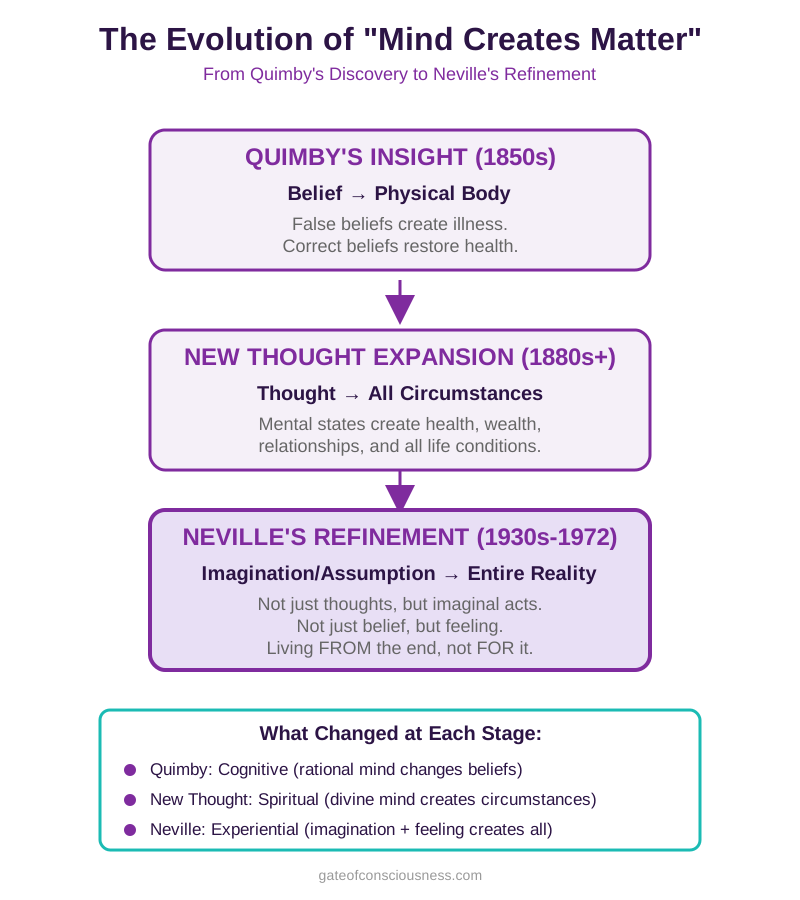
Quimby relied on rational persuasion, not imagination or feeling.
He talked people out of their false beliefs through logical argument. He didn’t teach visualization, didn’t mention SATS, never discussed the importance of feeling states.
His method was entirely cognitive—change the thought, and the body follows.
Compare this to Neville Goddard, who taught that you must feel your desire as already fulfilled, must imagine it so vividly that it becomes more real than your current circumstances. Quimby was all head; Neville understood you needed the heart too.
Phineas Quimby and the Law of Attraction: What’s the Connection?
Is Phineas Quimby the founder of the Law of Attraction?
The answer is nuanced.
Technically, no. Quimby never used that term or taught “attraction” as we understand it today.
But here’s what he did teach: Your beliefs attract corresponding physical experiences.
If you believe you’re sick, you’ll experience sickness. If you believe you’re well, you’ll experience health.
Your internal state determines your external reality. That’s the Law of Attraction in everything but name.
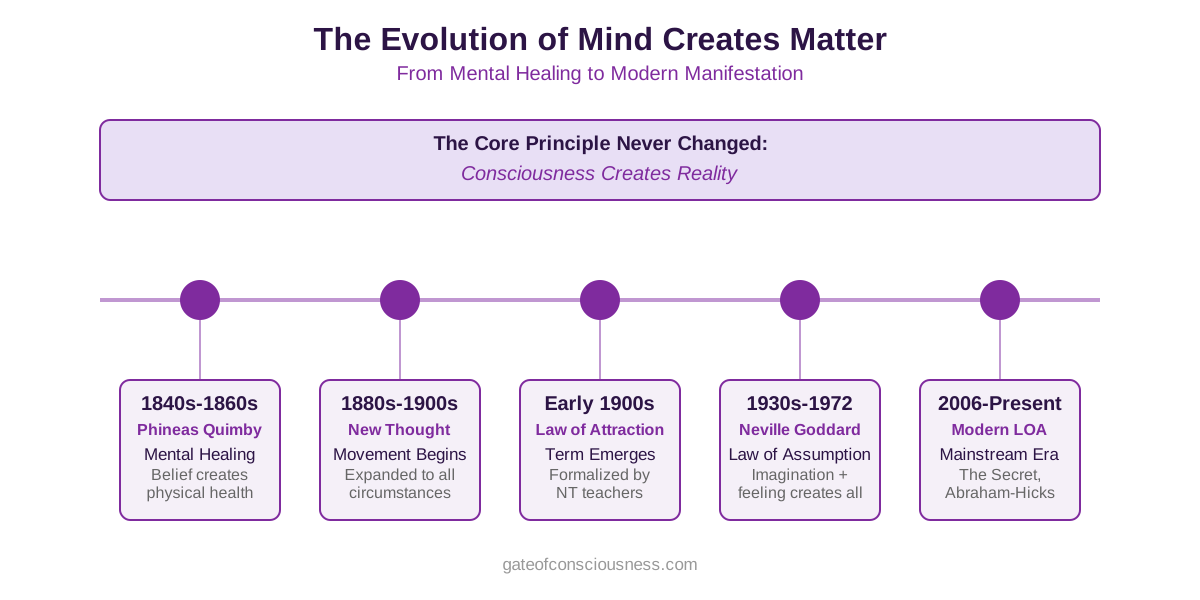
The Historical Timeline
Understanding how Quimby’s work evolved into modern LOA helps clarify what he contributed versus what came later:
1840s-1860s: Phineas Quimby
Discovers and documents that thoughts create physical health and illness. Treats thousands of patients using mental healing methods. Dies in 1866 without publishing his work.
1880s-1900s: New Thought Movement
Quimby’s students (Warren Felt Evans, Julius Dresser) formalize his teachings into a broader philosophy. They expand from physical healing to include prosperity, relationships, and all life circumstances. The term “New Thought” is coined to describe this mind-centered spirituality.
Early 1900s: “Law of Attraction” Emerges
New Thought teachers like Thomas Troward, William Walker Atkinson, and Wallace Wattles begin using the term “Law of Attraction” to describe the principle that like attracts like, thoughts attract circumstances.
1970s-2000s: Modern LOA Popularization
Esther Hicks (Abraham-Hicks) revives interest in LOA. The Secret (2006) makes it mainstream. The core principle remains unchanged from Quimby’s original insight—just wrapped in different language.
What Quimby Contributed to the Law of Attraction
Quimby provided three things that every subsequent teacher built upon:
- Empirical evidence through documented case studies. Thousands of healings proving mind-over-matter wasn’t religious mysticism—it was a repeatable, observable principle.
- A systematic methodology. Not just “think positive,” but a specific process for identifying false beliefs, examining their source, and replacing them with truth.
- The bridge from faith to science. Quimby moved manifestation out of the realm of religious “faith healing” and into practical mental science that anyone could understand and apply.
What Got Added After Quimby
Modern Law of Attraction includes several elements Quimby never taught:
- Deliberate creation beyond healing (manifesting money, relationships, career)
- Vibration and frequency language (Abraham-Hicks’s “raising your vibration”)
- Universal laws framework (multiple “laws” working together)
- Visualization and feeling-state techniques (Neville’s SATS, emotional embodiment)
- Cosmic ordering (asking the universe for specific things)
Quimby would recognize the foundation, but he’d find the superstructure unfamiliar. And honestly? That’s fine. Every teacher builds on what came before.
From Quimby to Neville: How the Teaching Evolved
So if Quimby never taught manifestation as we know it, how did we get from his mental healing practice to Neville Goddard’s Law of Assumption?
The lineage is indirect but traceable.
The Direct Students
Warren Felt Evans studied directly with Quimby and became the first to publish New Thought books in the 1870s. He expanded Quimby’s health-focused teaching to include spiritual philosophy and broader life applications.
Britannica notes that Evans’s work helped systematize Quimby’s philosophy into a wider movement.
Julius Dresser was one of Phineas Quimby’s patients who experienced a dramatic healing. He and his son Horatio became the primary preservers of Quimby’s legacy, publishing his manuscripts in 1921 and writing extensively about his methods.
These first-generation students transformed Quimby’s practical healing methodology into a philosophical movement. By the 1880s, New Thought had spread across America, spawning multiple branches and schools.
The New Thought Expansion
From Quimby’s students came an explosion of teachers who each added their own insights:
- Emma Curtis Hopkins (called the “teacher of teachers”) trained Ernest Holmes, Charles and Myrtle Fillmore, and dozens of other influential figures
- Charles Fillmore founded Unity Church, focusing on prosperity consciousness
- Ernest Holmes created Science of Mind, emphasizing spiritual treatment
- Thomas Troward added philosophical rigor and the creative process framework
Each teacher took Quimby’s core principle (mind creates reality) and developed it in different directions. Some stayed focused on healing. Others emphasized prosperity. Still others developed it into comprehensive spiritual philosophies.
The Christian Science Branch
No discussion of Quimby is complete without mentioning Mary Baker Eddy, who studied with him in 1862 and later founded Christian Science.
The Christian Science trajectory diverged significantly from the New Thought lineage that influenced modern manifestation teaching. Where New Thought kept Quimby’s practical methodology and expanded it, Christian Science wrapped it in religious doctrine and restricted it to healing through prayer.
What Modern Manifestation Students Can Learn from Quimby
You might be wondering: Why study a teacher from the 1850s when we have Neville, Abraham-Hicks, and countless modern teachers?
Because Quimby’s work offers something contemporary teachers often gloss over: the rigorous process of belief examination.
Lesson 1: Belief Examination Works (And You’re Probably Skipping It)
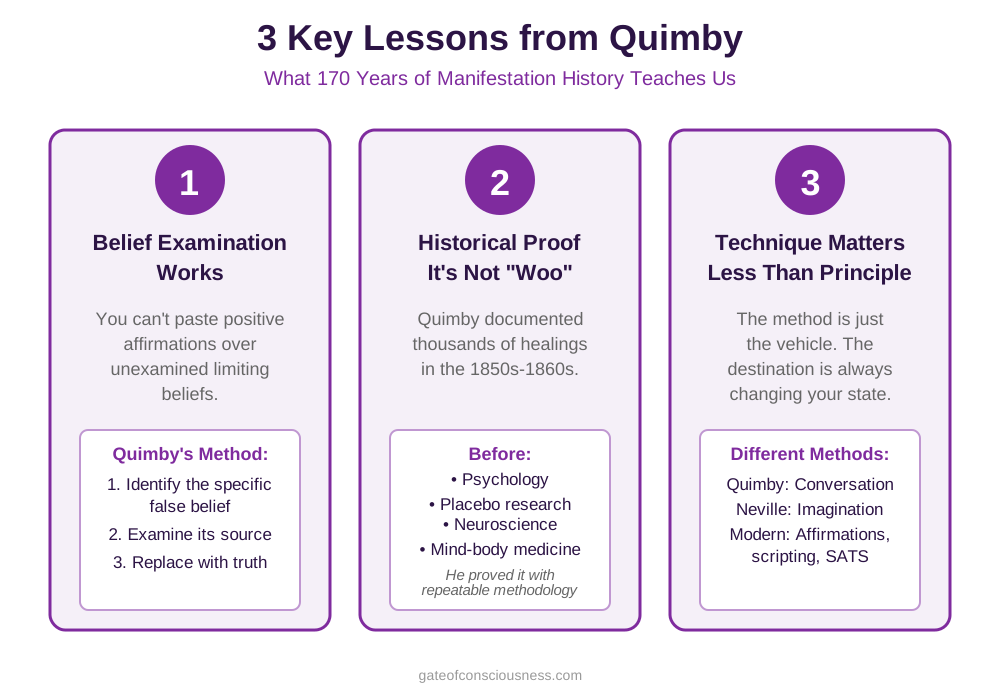
Quimby didn’t just tell patients to affirm health. He spent hours uncovering the specific false belief causing their illness. Only after identifying the root belief would he work to replace it with truth.
Modern manifestation students often skip this step, jumping straight to affirmations without examining what they actually believe underneath. Your nervous system won’t accept “I am wealthy” if you have an unexamined belief that “money corrupts people.”
You must address the underlying error first, just as Quimby taught. This is why overcoming limiting beliefs is such crucial work.
Lesson 2: Historical Proof That Mind-Over-Matter Isn’t “Woo”
Quimby was documenting thousands of healings in the 1850s and 1860s—before psychology existed as a field, before placebo effect research, before neuroscience. While mainstream doctors were still bloodletting, Quimby was proving that changing beliefs changed bodies with repeatable methodology.
This isn’t modern invention. It’s rediscovery of ancient truth that Quimby documented with 19th-century scientific rigor.
Lesson 3: The Technique Matters Less Than the Principle
Quimby used conversation. Modern teachers use visualization, affirmations, scripting, SATS, and countless other techniques.
What matters isn’t the specific method—it’s the principle: Changing the assumption/belief. Don’t get overly attached to one technique. The destination is always the same: shifting your state of consciousness.
Where Quimby Falls Short
For all his brilliance, Quimby had limitations:
He only worked with physical healing, relied on the rational mind, and had no framework for manifesting from desire.
This is why studying Quimby alone isn’t enough. You need his foundation, combined with Neville’s imagination techniques and modern understanding of nervous system regulation.
Standing on Quimby’s Shoulders
Here’s what Phineas Quimby proved 170 years ago, long before neuroscience could explain it: Mind creates matter. Belief becomes biology. Assumption manifests as reality.
Here’s what stayed absolutely true from 1850 to today:
You cannot manifest from a state of consciousness that contradicts your desire.
Quimby’s work reminds us that effective manifestation requires:
- Honest examination of what you actually believe (not what you wish you believed)
- Identification of specific errors in your thinking (not just “I need to be more positive”)
- Systematic replacement with truth (not just hoping the new belief will stick)
- Patience for the external to reflect the internal change (not demanding instant results)
Every modern technique—from Neville’s SATS to revision work to mental diet—ultimately does what Quimby did: changes the belief so reality can change to match.
Want to understand how other historical teachers influenced modern manifestation work?
Check out my complete guide: 15 Manifestation Teachers and Authors Similar to Neville Goddard.
Common Questions About Phineas Quimby
Who was Phineas Quimby and what was his background?
What did Phineas Quimby believe?
Is Phineas Quimby the founder of the Law of Attraction?
What were Phineas Quimby’s methods and how did they claim to cure illness?
Did Phineas Quimby write any books or lectures?
What were Quimby’s methods and how did they claim to cure illness?
Who were some notable disciples or associates of Phineas Quimby?
Were Phineas Quimby’s teachings connected to organized religion or ministers?
What kinds of illnesses did Phineas Quimby claim to treat?
How do scholars analyze Phineas Quimby today—what are the main interpretations?
Where can I find primary sources and archives about Quimby’s work?