Neville Goddard’s Influences: From Mystic Abdullah to William Blake and Kabbalah
⚡ Neville Goddard’s Influences Key Takeaways
- Abdullah was Neville’s most direct and transformative mentor — a mysterious mystic from Ethiopia who taught him to read the Bible as psychological allegory, and demonstrated the law of assumption to him in real life.
- William Blake was Neville’s greatest intellectual love. He quoted Blake’s poems more than any source outside the Bible and described them as “closely woven in the tapestry of thought.”
- The New Thought movement gave Neville the philosophical scaffolding for his teachings on consciousness — and he then pushed those ideas far beyond where any New Thought teacher had gone before.
- Neville reinterpreted the Bible not as historical record but as a map of human consciousness — a reading shaped by Kabbalah and esoteric mysticism passed to him by Abdullah.
- His influence ran both ways: Reverend Ike (Frederick Eikerenkoetter) acknowledged that Neville’s teachings shaped his entire philosophical framework on prosperity and consciousness.
Table of Contents:
From Barbados to a Life-Changing Encounter
Neville Lancelot Goddard was born in 1905 in Fontabelle, Barbados, the fourth of ten children in a merchant family. At 17, he sailed to New York City to study drama, dancing his way through vaudeville stages and performing at the Hippodrome. Not exactly the typical origin story for one of the twentieth century’s most radical mystics.
It was during those New York years, as the Great Depression dismantled his theatrical career, that Neville’s attention turned fully toward metaphysics and spirituality. He had already begun exploring esoteric ideas after meeting a Scotsman named Arthur Begbie on a European tour, who introduced him to spiritualistic séances.
But the real turning point came when he walked into a Harlem lecture hall and met a man known only as Abdullah. What followed was a ten-year apprenticeship that would shape every lecture, every book, and every teaching Neville would ever deliver.
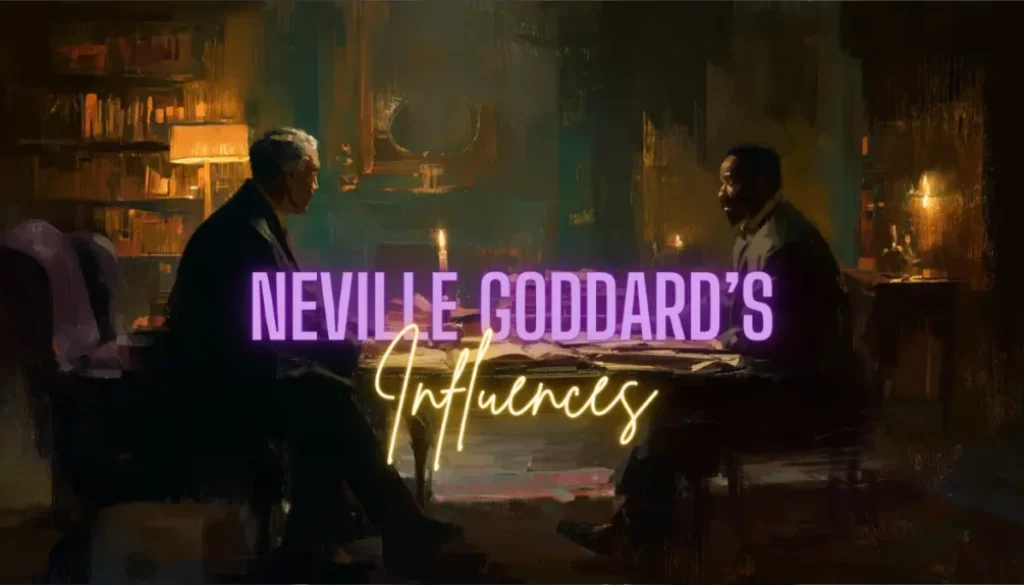
To understand who inspired Neville Goddard, you have to start here — not with the books on his shelf, but with the man who sat across from him and said:
“As far as I am concerned, you are already in Barbados.”
Neville Goddard’s Key Influences at a Glance
What Abdullah taught Neville was nothing short of a complete rewiring of how he read the world. At the core was a Kabbalistic and esoteric interpretation of the Bible — not as a literal historical account, but as a psychological allegory of human consciousness.
Every figure in scripture, from Moses to Jesus, represented a state of mind rather than a historical person. This reading became the backbone of every Neville Goddard lecture that followed.
Abdullah also gave Neville something more personal: a direct, embodied lesson in the Law of Assumption. The famous story goes that Neville wanted to visit Barbados but had no money for the trip. Abdullah insisted he was already in Barbados and refused to engage with any discussion suggesting otherwise.
Within weeks, Neville received a first-class ticket as a gift from his brother. It was the moment Neville described as proof that assumption, fully held, becomes fact.
You can learn more about Abdullah’s mysterious life and teachings in my dedicated post on the Ethiopian mystic Abdullah.
💡 Pro Tip
The Barbados story isn’t just a nice anecdote. It’s the clearest example of what the Law of Assumption actually looks like when practiced without compromise. Abdullah didn’t “try” to hold the assumption. He simply had no internal room for any other reality. That’s the standard Neville spent thirty years teaching people to reach.
William Blake: The Poet Who Became a Philosophical North Star
If Abdullah shaped Neville’s method, William Blake shaped his entire metaphysical worldview. Blake (1757–1827) was an English visionary poet and artist who spent his life insisting that the human imagination was not just a creative faculty — it was divine.
“Man is all Imagination,” Blake wrote. “God is Man and exists in us and we in Him. The Eternal Body of Man is the Imagination, that is, God Himself.”
Neville quoted Blake’s poems more than any other source outside the Bible.
In his lecture The Ultimate Sense, he wrote:
“I know the truth of that statement, for although Blake was born in 1757 and died in 1827, we are closely woven in the tapestry of thought.”
That’s not casual admiration. Neville considered a poet who died 78 years before he was born essentially his intellectual twin.
What drew Neville to Blake so deeply was their shared approach to scripture. Like Neville, Blake read the Bible as pure allegory — a symbolic map of the inner world. Both rejected the idea of an external God sitting in judgment and replaced it with something far more radical: the human imagination as the only God there is. Blake saw every biblical figure as an eternal state of consciousness, not a historical character. Sound familiar? It should — because that’s exactly how Neville taught it.
Blake’s poem Jerusalem was a particular touchstone. In it, Blake wrote that the only gospel worth following was “the liberty both of body and mind to exercise the divine arts of imagination.” Neville delivered versions of this idea in hundreds of lectures across thirty years. The influence wasn’t academic — it was cellular.
“All that you behold, though it appears without, it is within, in your imagination, of which this world of mortality is but a shadow.” — William Blake, quoted by Neville Goddard in his lectures
The New Thought Movement: A Framework for the Mind
Neville didn’t emerge from a vacuum. By the time he began lecturing in the 1930s, a whole tradition of metaphysical thought had already been building in America for decades.
He absorbed it thoroughly.
The New Thought movement, which gave us teachers like Ernest Holmes (founder of Religious Science) and Thomas Troward (a retired British judge who wrote The Edinburgh Lectures on Mental Science), had already established a foundational idea:
The mind is not just a receiver of reality, it is a creator of it.
Neville read Thomas Troward Wikipedia carefully.
Troward was one of the first writers to attempt a philosophical and near-scientific argument for why consciousness precedes physical form — arguing that universal mind operates through individual minds as its instrument. Neville took this framework and pushed it much further, removing the abstract “universal mind” middleman and placing the human imagination directly at the center of creation.
Ernest Holmes and his Science of Mind were also part of Neville’s intellectual ecosystem, as was the broader tradition of New Thought that included figures like Charles Fillmore of the Unity movement.
What’s worth mentioning is how Neville diverged from most New Thought teachers:
Where they often emphasized affirmation, positive thinking, and aligning with universal law, Neville cut straight to assumption and imagination.
He wasn’t interested in thinking positively about the future. He insisted you occupy the end result now, in consciousness, as a present fact.
This is why Neville is often described as “New Thought’s most radical voice.”
He took the movement’s central premise — mind shapes reality — and stripped away every hedge, qualifier, and halfway measure around it. Understanding what manifesting really means becomes much richer when you see it against this historical backdrop.
The Bible and Kabbalah: Scripture as a Map of Consciousness
The most common misconception about Neville Goddard is that he was a Christian teacher. He wasn’t — at least not in any conventional theological sense.
His theology, if you want to call it that, had no church. What Neville did was take biblical scripture and completely reinterpret it through the lens of psychology, mysticism, and the Kabbalah that Abdullah had taught him.
In Neville’s reading, every biblical story is a metaphor for processes happening inside human consciousness.
The story of Moses leading people out of Egypt isn’t about historical slavery.
It’s about freeing the mind from limiting beliefs. Jesus isn’t a figure to worship externally but a symbolic representation of the awakened human imagination.
The crucifixion and resurrection are about the death of the old self-concept and the birth of a new identity.
Heavy stuff for a Sunday morning, but Neville delivered it with complete conviction.
The Kabbalistic thread is less visible in Neville’s work but runs deep.
Abdullah introduced him to the idea that the Hebrew letters and names in scripture carry specific vibrational and psychological meanings — that “I AM” (the divine name YHWH) is not an external deity but the core of human consciousness itself.
This is also what makes Neville’s I AM meditation so different from a standard mindfulness practice — it’s rooted in a specific mystical tradition about the nature of the self.
🔬 Research Note
Historian and Neville scholar Mitch Horowitz, writing in his book The Miracle Club (St. Martin’s Press, 2018), documents how Neville “achieved popularity by reinterpreting the Bible and the poetry of William Blake” — confirming that these two sources were the most publicly acknowledged pillars of his teaching. Horowitz is one of the few mainstream historians to take Neville’s work seriously as a philosophical tradition, not just a self-help trend.
Emanuel Swedenborg: The Invisible Thread
Emanuel Swedenborg (1688–1772) is one of history’s strangest and most underrated figures — a Swedish scientist who, in his later years, claimed to receive direct visions from the spiritual world and spent the rest of his life writing encyclopedic accounts of what he saw there.
His core idea: the Bible operates on multiple simultaneous levels of meaning, and the spiritual world is the causal reality behind the physical one.
Neville never cited Swedenborg as often as Blake or Abdullah, but dismissing him as irrelevant misses something important.
Swedenborg’s influence flowed into Neville’s world through three separate channels simultaneously:
- Through Blake (who was deeply shaped by Swedenborgianism before ultimately rejecting parts of it),
- The New Thought movement (which drew heavily on Swedenborg’s idea that material reality flows from spiritual causes),
- And through the very Kabbalistic tradition Abdullah passed to Neville. Swedenborg sits at the origins of much of what Neville taught.
The Chain of Metaphysical Influence
The Influence Ran Both Ways: Neville and Frederick Eikerenkoetter [Reverend Ike]
Here’s a detail that often gets left out of the Neville Goddard story:
Neville didn’t only receive influence — he generated it.
And one of the clearest examples is Frederick Eikerenkoetter II, far better known as Reverend Ike.
Reverend Ike (1935–2009) was one of the most charismatic prosperity preachers of the twentieth century, famous for his flamboyant style, his Rolls-Royces, and his unapologetic message that poverty was not spiritual virtue.
What fewer people know is that according to a Harvard Divinity School professor, Jonathan L. Walton, Eikerenkoetter directly acknowledged that Neville Goddard’s teachings shaped his entire philosophical framework.
After the Bible, Reverend Ike’s second all-time favorite book was Neville’s Resurrection.
He cited Neville’s emphasis on self-image and present-tense consciousness:
“You never attract what you want; you always attract what you are conscious of being”
— as the intellectual engine behind his own prosperity gospel.
Neville’s idea that consciousness now is what determines experience later gave Ike the framework to preach that wealth begins inside, not outside.
This connection matters because it shows the reach of Neville’s ideas beyond the quiet world of metaphysical lectures.
If you’re curious about other contemporary teachers who carry Neville’s lineage forward, my post on 15 manifestation teachers similar to Neville Goddard maps the whole landscape.
💡 Pro Tip
If you want to go deeper into Neville’s actual techniques — the ones built directly from Abdullah’s teaching — start with the revision technique and the state akin to sleep. Both are direct expressions of the Kabbalistic imagination practice Abdullah demonstrated to him in real life.
Why Neville’s Sources Still Matter for Your Practice
You might be wondering why any of this history is relevant to whether you can manifest a relationship, a job, or a state of inner peace.
Here’s why it matters:
Knowing where Neville’s ideas came from helps you understand what they actually are.
Neville was synthesizing thousands of years of mystical, philosophical, and esoteric thought.
Everything from Kabbalistic scripture interpretation to Blake’s visionary poetry to the lived demonstration of assumption he received from Abdullah, and translating it into something any ordinary person could apply on a Tuesday afternoon.
That’s the genius.
The ideas are ancient.
The delivery was modern.
None of this makes the Law of Assumption less practical. If anything, understanding its depth makes it harder to dismiss as wishful thinking. T
These people were rigorous thinkers who had the philosophical and mystical courage to say: human consciousness is the creator of earthly experience, and the power of imagination is how that creation happens.
That’s the tradition you’re working with every time you practice the Law of Assumption. It’s a long line of people who tested it, refined it, and passed it forward. Neville just happened to be the one who made it impossible to ignore.