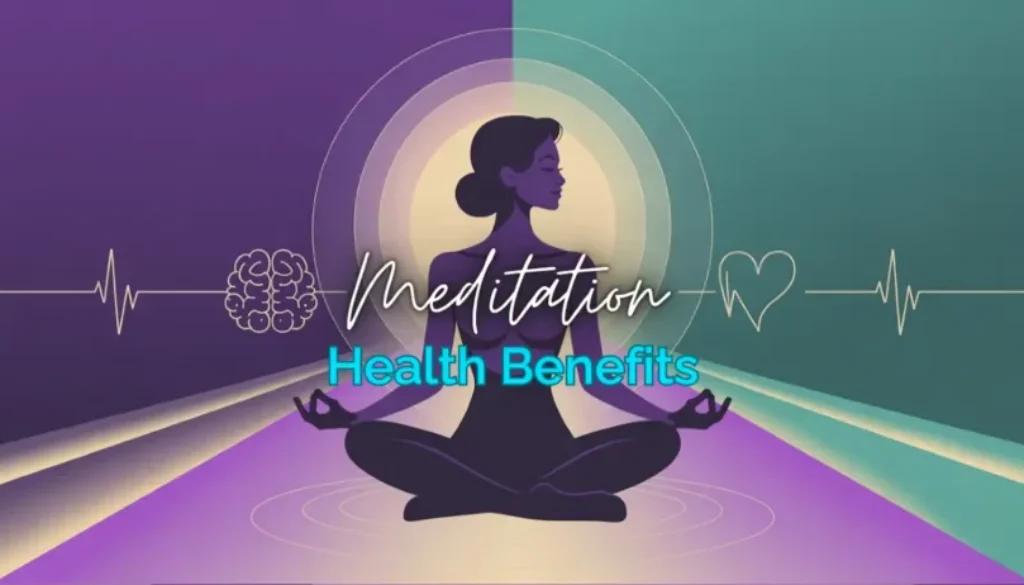
Meditation Health Benefits: What the Science Actually Says About the Benefits of Meditation for Mental and Physical Health

🔑 Meditation Health Benefits: Key Takeaways
- Cortisol reduction is measurable: Meta-analyses confirm meditation lowers the primary stress hormone, often significantly.
- The brain physically changes: Regular practice increases cortical thickness and reduces amygdala reactivity.
- Blood pressure responds: Clinical studies show consistent reductions in both systolic and diastolic pressure.
- The immune system benefits: Research links meditation to reduced inflammation markers and improved immune cell activity.
- The nervous system is the bridge: Chronic stress dysregulation blocks the body’s ability to heal — meditation is the reset.
Table of Contents:
Meditation and Stress Reduction: The Cortisol Connection
Of all the meditation health benefits studied in clinical settings, cortisol reduction has the most robust evidence behind it.
Cortisol is the hormone your body releases in response to stress — useful in short bursts, damaging when chronically elevated. It suppresses immune function, disrupts sleep, raises blood pressure, and over time, contributes to a wide range of health conditions, including inflammatory disease.
People who meditate regularly show measurably different cortisol profiles than those who don’t — and this effect appears regardless of the specific type of meditation practice used.
A 2024 meta-analysis published in Psychoneuroendocrinology analyzed 58 randomized controlled trials involving over 3,500 participants.
The results showed that mindfulness and meditation interventions produced a medium positive effect on cortisol levels compared to control conditions — with mindfulness-based approaches specifically showing an effect size of 0.345.
In plain terms:
Meditation measurably moves the needle on your body’s primary stress hormone.
Why Cortisol, Anxiety and Stress Are Linked to Physical Health
Most people think of stress as a mental experience. But cortisol is a physical one. When it runs high for weeks or months, it creates a cascade of downstream health consequences:
- disrupted digestion,
- hormonal imbalance,
- poor sleep quality,
- increased inflammatory markers,
- and a suppressed immune response.
The body operating in a state of low-grade alarm isn’t just tired — it’s biochemically unable to prioritize healing and repair.
🔬 Research Note: A 2023 clinical trial at the University of São Paulo found that a mindfulness-based program significantly reduced hair cortisol concentrations — a long-term stress biomarker — alongside self-reported anxiety and perceived stress in university workers experiencing high stress levels. Hair cortisol reflects weeks of cumulative exposure, not just one day. That distinction matters.
How Meditation Helps: What It Does to the Brain
Meditation doesn’t just calm you down in the moment — it physically changes the architecture of your brain over time. This is one of the more remarkable meditation health benefits to emerge from neuroimaging research in the last decade.
Mindfulness-Based Structural Changes: The Brain Gets Thicker
A 2024 systematic review published in Biomedicines synthesized research across PubMed, Cochrane Library, and Embase and found that mindfulness practice is associated with increased cortical thickness, reduced amygdala reactivity, improved brain connectivity, and better neurotransmitter regulation.
The prefrontal cortex — responsible for rational decision-making, emotional regulation, and impulse control — shows measurable improvements in function and structure in regular meditators.
The amygdala, which is your brain’s threat-detection center, becomes less reactive. This matters practically: you still respond to genuine stressors, but you stop treating neutral situations as emergencies.
That is not a small change. For many people, a hyperreactive amygdala is the engine behind chronic anxiety, relationship conflict, and the relentless sense that something is about to go wrong.
Neuroplasticity, Emotional Health, and Healing
The science of neuroplasticity tells us the brain can rewire itself based on repeated experience.
Meditation creates that experience deliberately: you are conditioning your brain toward calm, toward present moment awareness, toward regulation — the same way athletes condition their muscles.
The meditation benefits accumulate with each session: the brain that meditates consistently becomes structurally different from the one that doesn’t. That structural difference has measurable health consequences.
Prefrontal Cortex
Increased cortical thickness and improved function. Better emotional regulation, focus, and rational decision-making.
Amygdala
Reduced reactivity to perceived threat. Less anxiety, less emotional hijacking, less chronic fight-or-flight activation.
Neurotransmitters
Improved serotonin and dopamine regulation. Better mood baseline, more stable energy, and greater resilience under pressure.
Blood Pressure and Cardiovascular Health
High blood pressure affects nearly half of all adults in the US, and the conventional solution is pharmaceutical.
Meditation is not a replacement for medication — but the evidence that it meaningfully reduces blood pressure is substantial enough that the American Heart Association has acknowledged it as a complementary approach.
In 2017, the American Heart Association issued a formal Scientific Statement reviewing the evidence for meditation in cardiovascular risk reduction. The statement concluded that meditation may be considered as a reasonable adjunct to standard cardiovascular care, with the strongest evidence for reductions in systolic blood pressure.
A separate 2025 review in Cogent Mental Health found mindfulness-based interventions improve cortisol and inflammatory markers, though evidence on heart rate variability remains mixed.
The mechanism is fairly direct:
Chronic stress activates the sympathetic nervous system, which raises heart rate and blood pressure as a survival response. Meditation activates the parasympathetic nervous system — the “rest and repair” branch — which signals the heart and vascular system to stand down.
Do that consistently, and the body’s cardiovascular baseline shifts.
The Immune System Health Benefits of Meditation
This is where the mental and physical health benefits of meditation get genuinely surprising.
A systematic review of 20 randomized controlled trials with over 1,600 participants, published in Annals of the New York Academy of Sciences, found that mindfulness meditation modulates immune parameters in ways that suggest a more health-promoting immune profile.
Specifically:
Reductions in pro-inflammatory processes, increases in cell-mediated defense, and increases in enzyme activity that protects against cellular aging.
The research shows meditation may help support immune resilience in ways conventional medicine is only beginning to document.
Inflammation, Telomeres, and Age-Related Cellular Health
Two of the more striking immune findings involve inflammation and cellular aging. Research has linked regular meditation practice to reductions in pro-inflammatory cytokines — the signaling proteins that drive conditions like autoimmune disorders, chronic pain, and metabolic disease.
Separately, studies have found that meditators show healthier telomere activity.
Telomeres are the protective caps on your DNA strands; shorter telomeres correlate with accelerated aging and increased disease risk. Meditation appears to slow that shortening process.
A landmark large-scale genomic study published in PNAS found that an advanced meditation retreat produced robust activation of immune system gene expression in participants — changes that were attributable to the meditation practice itself, not diet or sleep variation.
That level of biological response to a non-pharmaceutical intervention is notable.
Over 1,600 participants showed preliminary evidence that mindfulness meditation produces a more health-promoting immune profile — including reduced inflammation and improved cellular defense mechanisms.
Source: Black & Slavich, Annals of the New York Academy of Sciences
Sleep, Energy, and Inflammation: What Mindfulness-Based Stress Reduction Shows
Poor sleep and chronic fatigue are two of the most common complaints in adults — and two of the most reliable downstream effects of chronic stress activation.
Elevated cortisol, a hyperactive amygdala, and a nervous system stuck in high gear all interfere with the body’s ability to move into deep, restorative sleep.
The physiological case for meditation extends well beyond subjective stress reduction. A 2017 meta-analysis of 45 randomized controlled trials, published in the Journal of Psychiatric Research, examined meditation’s effect on physiological stress markers specifically using studies that compared meditation to an active control — the most methodologically rigorous comparison available. The results showed that meditation reduced six distinct biomarkers of stress activation: cortisol, C-reactive protein, blood pressure, heart rate, triglycerides, and tumor necrosis factor-alpha (TNF-α), a key driver of systemic inflammation. Notably, all meditation subtypes reduced systolic blood pressure, while focused-attention practices also reduced cortisol specifically.
Six Biomarkers That Shift With Regular Practice
Meta-analysis of 45 RCTs (Pascoe et al., J Psychiatr Res, 2017)
Cortisol
The primary stress hormone. Reduced especially with focused-attention meditation.
Blood Pressure
Systolic BP dropped across every meditation subtype studied.
C-Reactive Protein
A core inflammation marker tied to cardiovascular and autoimmune risk.
Resting Heart Rate
A direct readout of sympathetic vs. parasympathetic balance.
TNF-α
Inflammatory cytokine involved in autoimmune and chronic-pain conditions.
Triglycerides
Blood lipid levels connected to metabolic and cardiovascular health.
The sleep improvement isn’t incidental here.
When the nervous system downregulates through regular meditation, sleep architecture improves because the system that was preventing it is no longer running at full activation.
For people experiencing chronic fatigue alongside poor sleep, this is significant.
The exhaustion isn’t usually caused by doing too much. It’s often caused by a nervous system that never fully switches off — one that stays in low-grade alert even during rest. Nervous system regulation addresses this at the root, not just the symptom level.
Ready to Experience It for Yourself?
The Body Harmony Bundle is designed specifically for people who want to use meditation to create real physical change, not just relaxation. Enter your email below and I’ll send you the guided meditation plus the Affirmation Blueprint: Body Goals workbook.
Straight to your inbox. No spam. Unsubscribe anytime.
💡 Pro Tip: The most effective time to meditate for sleep improvement is the 30–60 minutes before bed — not because of relaxation alone, but because it creates a physiological transition signal that tells your nervous system the threat-response period is over for the day.
The Layer Most People Miss: Your Nervous System
Here is the part that requires a different frame than conventional wellness.
Every meditation health benefit described above — cortisol reduction, brain changes, blood pressure improvement, immune function, better sleep — works through a single mechanism: moving your nervous system from sympathetic (threat-response) activation to parasympathetic (rest-and-repair) regulation.
The Power of Meditation: Sympathetic vs. Parasympathetic Explained
Your autonomic nervous system runs in two primary modes. Sympathetic mode is your fight-or-flight response — it prioritizes survival by redirecting resources away from digestion, immune function, tissue repair, and hormonal balance toward immediate physical action.
This is brilliant in a genuine emergency. The problem is that modern stress — financial pressure, relationship tension, identity anxiety, chronic worry — keeps the sympathetic system activated even when there is no physical threat.
The body doesn’t distinguish between a charging tiger and a difficult conversation your mind keeps rehearsing at 2am. Both trigger the same biochemistry.
Chronically elevated sympathetic activation is the common upstream cause of most of the physical conditions meditation research documents.
It isn’t that meditation treats stress, blood pressure, inflammation, and immune function separately. It addresses the single upstream driver that produces all of them.
- Elevated cortisol & adrenaline
- Suppressed immune response
- Disrupted sleep and digestion
- Heightened inflammation
- Reduced tissue repair
- Cortisol normalizes
- Immune function restored
- Deep, restorative sleep
- Inflammation decreases
- Active healing and repair
Years before I understood any of this clinically, my body was already showing me what chronic sympathetic activation looks like from the inside:
Irritable bowel syndrome (IBS), low energy, a baseline exhaustion no amount of sleep fixed.
The diagnosis was “permanent.” The resolution came not from a protocol but from consciousness work — specifically from the kind of deep meditation that moved my system into genuine parasympathetic rest for the first time in years.
I don’t soften what I say about the body-mind connection because I’ve lived both sides of it.
When You Practice Meditation: Benefits That Go Beyond Stress Relief
This is where meditation as a health tool and meditation as a consciousness practice converge — and where the results tend to surprise people.
When the nervous system is chronically dysregulated, trying to change body-level outcomes through willpower alone is fighting upstream. Jennifer, a client I worked with on body image and physical transformation, had tried diet after diet for years.
When we traced the pattern, she’d been operating from a stress-body state the entire time — her system was in low-grade threat mode, her cortisol was elevated, and her body’s default response was to hold on, not release.
When we worked at the level of identity and nervous system regulation — not the food behaviors themselves — she described her relationship with her body as “just… normal now. I don’t think about it.”
She lost 15 pounds and gained muscle in two months, without pushing herself for the first time in her life.
This is what manifesting at the body level actually looks like. Not forcing outcomes with techniques, but creating the internal conditions — regulated nervous system, shifted identity, reduced cortisol baseline — that allow the body to do what it’s designed to do.
The Law of Assumption teaches that the body expresses what consciousness holds as true. The science of stress physiology says the same thing in different language.
In 16 years of working with clients on body-level goals, the consistent pattern is this: the people who change fastest are the ones who stop treating their body as the problem and start treating it as the messenger.
How to Practice Meditation: Techniques to Start Without Overwhelm
Even brief, consistent sessions produce measurable physiological changes. Here’s how to build a practice that actually holds:
Start with 5–10 minutes
Consistency outperforms duration. A 7-minute daily practice done consistently rewires the nervous system faster than a 45-minute session done twice a month.
Prioritize breath and body over mental emptiness
You don’t need to stop thinking. You need to shift attention from mental rehearsal of stressors to present-moment sensation. The nervous system responds to the redirect, not the silence.
Add intention once the body learns to settle
Once your nervous system can reliably reach a regulated state, that state becomes the foundation for deeper work — identity-level shift, conscious creation, the kind of inner change that produces outer results without force.
Use guided meditation when you’re starting out
Especially if you’re dealing with chronic anxiety or stress, trying to meditate without guidance is like trying to run a marathon without coaching. A well-structured guided practice does the nervous system regulation work for you while you learn how it feels.
💡 Pro Tip: The moment you notice your attention has wandered during meditation and bring it back — that’s not a failure. That noticing and returning is literally the practice. It’s the mental equivalent of a bicep curl. Each redirect builds the neural pathway you’re trying to develop.
📚 Related Reading
The Bottom Line on Meditation Health Benefits
Regular meditation practice measurably lowers cortisol, changes brain architecture, reduces blood pressure, modulates immune function, decreases inflammation, and improves sleep quality. These are documented physiological changes observed across hundreds of controlled clinical studies.
When the nervous system shifts from chronic sympathetic activation to genuine parasympathetic regulation, the body is finally able to do what it was designed to do. Heal. Repair. Restore.
The meditation isn’t adding something the body lacks. It’s removing the interference that was preventing the body from functioning as designed.
If you’re working toward physical goals — better health, a healthier body, more energy, less pain — the question worth asking isn’t which technique to add next. It’s whether your nervous system is regulated enough to receive what you’re working toward. For most people, that’s where the real work starts. And it’s also where the most profound changes happen.
FAQ About Meditation Health Benefits
How long does it take for meditation to show health benefits?
How much meditation per day is needed for health benefits?
Can meditation help with chronic pain and inflammation?
Is meditation a replacement for medical treatment?
What type of meditation is best for health benefits?
Is meditating good for your body?
Is 20 minutes of meditation equal to 4 hours of sleep?
How do you empty your mind during meditation?
Ready to Experience It for Yourself?
The Body Harmony Bundle is designed specifically for people who want to use meditation to create real physical change, not just relaxation. Enter your email below and I’ll send you the guided meditation plus the Affirmation Blueprint: Body Goals workbook.
Straight to your inbox. No spam. Unsubscribe anytime.